


Investors
GIMS has been conceived as a strategic intelligence platform, not as a technology infrastructure company. Its value proposition does not lie in owning data centers, communications networks or computing resources, but in developing proprietary methodologies capable of transforming heterogeneous information into high-value strategic intelligence.
From its inception, the company’s architecture has adopted an asset-light model based on a deliberate separation between physical infrastructure and proprietary intelligence. Infrastructure is an enabling resource, while knowledge, mathematical models and inference algorithms represent the organization’s true strategic assets.
This approach reflects both a business and a technological decision. Computing infrastructure evolves rapidly and can be sourced from multiple specialized providers through flexible and scalable procurement models. Intelligence, by contrast, requires years of research, validation and accumulated knowledge, creating a much more difficult barrier to entry to replicate.
Consequently, GIMS avoids tying up capital in assets whose technological evolution is rapid and whose competitive differentiation is limited. The company’s resources are instead directed primarily toward the development of intellectual property, World State representation models, probabilistic inference algorithms, structured knowledge bases and systemic analysis methodologies.
This strategy provides three fundamental advantages. First, it significantly reduces initial investment requirements and improves capital allocation efficiency. Second, it preserves the system’s technological independence, allowing new computing architectures, specialized accelerators or artificial intelligence models to be incorporated without altering the foundations of GIMS. Finally, it concentrates research efforts on the components that constitute the platform’s true competitive advantage and whose replication by third parties is considerably more difficult.
GIMS’s long-term vision is not to build the largest computing infrastructure, but to develop a cognitive infrastructure capable of operating on top of whatever technological platform is available. Advances in computing should become a multiplier of GIMS’s capabilities, never a constraint on its development.
For this reason, the company does not seek to compete with cloud infrastructure providers, hardware manufacturers or developers of foundation artificial intelligence models. Its position within the value chain is at a higher layer: the layer where information is transformed into structured knowledge, knowledge into probabilistic inferences, and inferences into strategic intelligence that can support decision-making.
At GIMS, infrastructure is an enabler. Intelligence is the product, the strategic asset and the primary source of value creation.
GIMS’s decoupled architecture also allows new information sources and indicators to be incorporated without modifying the system’s mathematical core.
ADE-1 is an industrial technology company focused on redefining how production systems are designed, deployed, and operated.
For decades, industrial environments have relied on fragmented software architectures composed of ERP, MES, PLC, and planning systems, each operating with partial representations of reality. This fragmentation introduces inefficiencies, instability, and increasing operational complexity.
ADE-1 addresses this problem at its root.
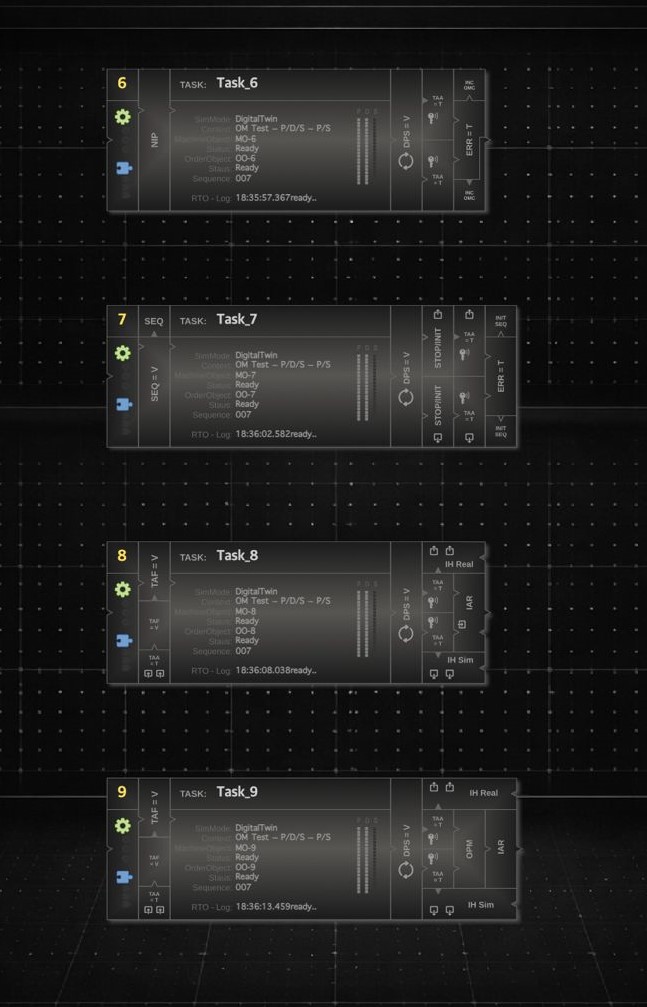
Instead of adding another layer or optimizing isolated decisions, ADE-1 introduces a unified system engine capable of generating fully operational industrial systems from a single model.
From one structured definition, the system produces:
• production control
• machine logic
• planning behavior
• data structures
• real-time execution and visualization
This approach eliminates the need for manual integration, reduces dependency on coding, and ensures that system behavior remains consistent with the physical process it represents.
The result is a new class of industrial system:
not programmed, not optimized — but generated.
With over two decades of development and real-world validation, ADE-1 is now transitioning from a validated system to a scalable industrial platform, opening access to partners, pilot deployments, and strategic investors.
ADE-1 is not software in the traditional sense.
It is an industrial system engine.
POSITIONING
ADE-1 introduces a new category in industrial technology: the Industrial System Engine.
Rather than optimizing decisions or integrating fragmented tools, ADE-1 generates complete, executable production systems from a unified model.
PROBLEM
Industrial systems today are inherently fragmented.
ERP manages data, MES handles execution, PLC controls machines, and planning tools attempt to optimize decisions. These layers operate independently, each based on partial abstractions of reality.
As system complexity increases, decision-making becomes unstable, integration costs grow, and operational inefficiencies accumulate.
SOLUTION
ADE-1 replaces the traditional stack with a single system engine.
Using an object-based model of the production system, ADE-1 generates:
• control logic
• execution systems
• planning behavior
• data structures
• real-time system visualization
The same model is used for both simulation and execution, ensuring consistency between virtual and physical systems.
DIFFERENTIATION
Unlike conventional solutions, ADE-1:
• does not rely on heuristics or approximations
• does not require manual programming
• does not separate planning from execution
• does not depend on fragmented system layers
Instead, it provides a physically consistent, executable representation of the full system.
Decisions are not calculated — they emerge from the system itself.
IMPACT
The impact is structural rather than incremental:
• improved operational stability
• reduced system complexity
• measurable efficiency gains
• scalability beyond human-driven planning
The system enables organizations to operate with a level of consistency and control not achievable through traditional architectures.
STRATEGY
ADE-1 follows a hybrid strategy combining open ecosystem development with proprietary core capabilities.
The goal is to accelerate adoption, enable industrial validation, and establish ADE-1 as the foundational layer for next-generation industrial systems.
CONCLUSION
ADE-1 does not improve existing systems.
It replaces them with a new paradigm.
From model to execution — automatically.
You didn’t come this far to stop